
Short answer: There is no federal busking permit in the US. Street music is generally treated as protected expression under the First Amendment, but cities can set content-neutral rules on time, place and manner, such as noise limits, sound permits and designated spots. Some cities need no permit at all, others license performers, and many only regulate certain zones or amplifiers.
Busking and the First Amendment
Courts in the US have generally treated music and street performance as a form of expression protected by the First Amendment. That does not mean anything goes. Cities may regulate the time, place and manner of expression, as long as the rules do not depend on the content of the performance, are narrowly tailored to a real government interest (such as noise or keeping sidewalks clear), and leave other ways to reach an audience.
In practice, this is why US busking rules focus on volume, hours, spacing and blocking the sidewalk rather than on what you play. This guide is general information, not legal advice. If you are cited or think a rule is unfair, talk to a lawyer or a local civil liberties group.
Two court cases worth knowing
- Ward v. Rock Against Racism (1989). The US Supreme Court upheld New York City's sound amplification guidelines for concerts at the Central Park bandshell, which required performers to use the city's sound system and technician. The Court said a content-neutral rule controlling volume is valid even if it is not the least restrictive option possible. It is often cited when cities set sound limits or require sound permits.
- Berger v. City of Seattle (9th Circuit, en banc, 2009). A street performer challenged the rules for performers at Seattle Center, including a permit and badge requirement and limits on how performers could approach and ask the public for money. The full appeals court found that key parts of those rules went further than the First Amendment allows, and the permit and badge rules were struck down.
Together they show the pattern: rules on volume and place are usually upheld, while blanket permit schemes and limits on speaking to people face closer scrutiny. Cities still run permit schemes in specific areas, so always follow local rules unless a court has said otherwise.
The three kinds of city rules
US cities fall into the same three groups seen worldwide, and the world busking map shows which applies where.
| City | Permit | Key rule |
|---|---|---|
| Boston | Not required on streets | Sound under 70 dB (50 dB from 11pm to 7am) |
| Austin | Not required on streets | Acoustic only, at or under 85 dB |
| Portland | Not required | Not plainly audible 100 feet away |
| Chicago | Required ($100 for two years) | No louder than normal conversation at 100 feet |
| Santa Monica | Required in the Promenade, Pier and Transit Mall area ($37 a year) | 75 dBA at 25 feet on weekday daytimes, 85 dBA evenings and weekends |
| New York City | Only for amplifiers ($45 NYPD sound device permit) | File at the local precinct at least five days ahead |
| Las Vegas | Registration on Fremont Street | Daily lottery for marked circles, 3pm to 1am |
| Denver | Free permit on 16th Street | Move every hour, 10am to 9pm |
Other cities on the map follow the same patterns. Salt Lake City and Savannah require a permit, Miami Beach licenses performers at 16 designated locations, and Boulder lets acoustic acts play on Pearl Street Mall without one.
Sound permits and amplifier rules
Amplification is where US rules are strictest, because noise control is the clearest government interest.
- New York needs an NYPD sound device permit for any amplified sound in public.
- Austin allows only acoustic busking on the street, and Pike Place Market in Seattle bans electronic amplification, brass and drums.
- Santa Monica requires speakers to sit on the ground, no more than three feet high, with no generators or plugging into buildings.
- In San Francisco, the city has no busker permit for amplified sound, and BART stations only allow unamplified music outside the fare gates.
- Seattle needs a park use permit for amplified sound in city parks.
A battery amp at a modest level is the safest setup in most cities, and a decibel meter app helps you check yourself against a stated limit.
Parks, markets and private plazas
Sidewalks, parks and markets are often run by different bodies. Austin needs a $10 per day Parks and Recreation permit in city parks, sold in two-week blocks. New York's busy Manhattan parks are reported to limit performers taking donations to medallion-marked spots. Seattle's Pike Place Market needs its own $35 annual permit, or $10 for one day. Boston's Faneuil Hall Marketplace is privately managed and reported to choose acts by audition.
Subways and transit
- New York: anyone may perform in subway stations without a permit under MTA rules: no amplification on platforms, no more than 85 dBA at five feet, and nothing on trains or buses.
- Boston: the MBTA Subway Performers Program issues a $25 permit and badge for signposted spots.
- San Francisco Bay Area: BART asks for its free expressive activities permit.
- Chicago: the city licence does not cover CTA or Metra stations and platforms.
Selling, fees and age
Tips are almost always fine, but charging a set fee is not. Santa Monica and Las Vegas both say you may not charge for a performance, only accept voluntary tips. Selling is treated separately: Chicago's licence can cover peddling only if you list what you sell, while Boston lets you sell recordings of your own performances.
Age limits vary. Chicago licenses only people aged 18 and over, Fisherman's Wharf performers must be 18, and in Santa Monica performers under 16 also need a California Entertainment Work Permit.
Taking tips without cash
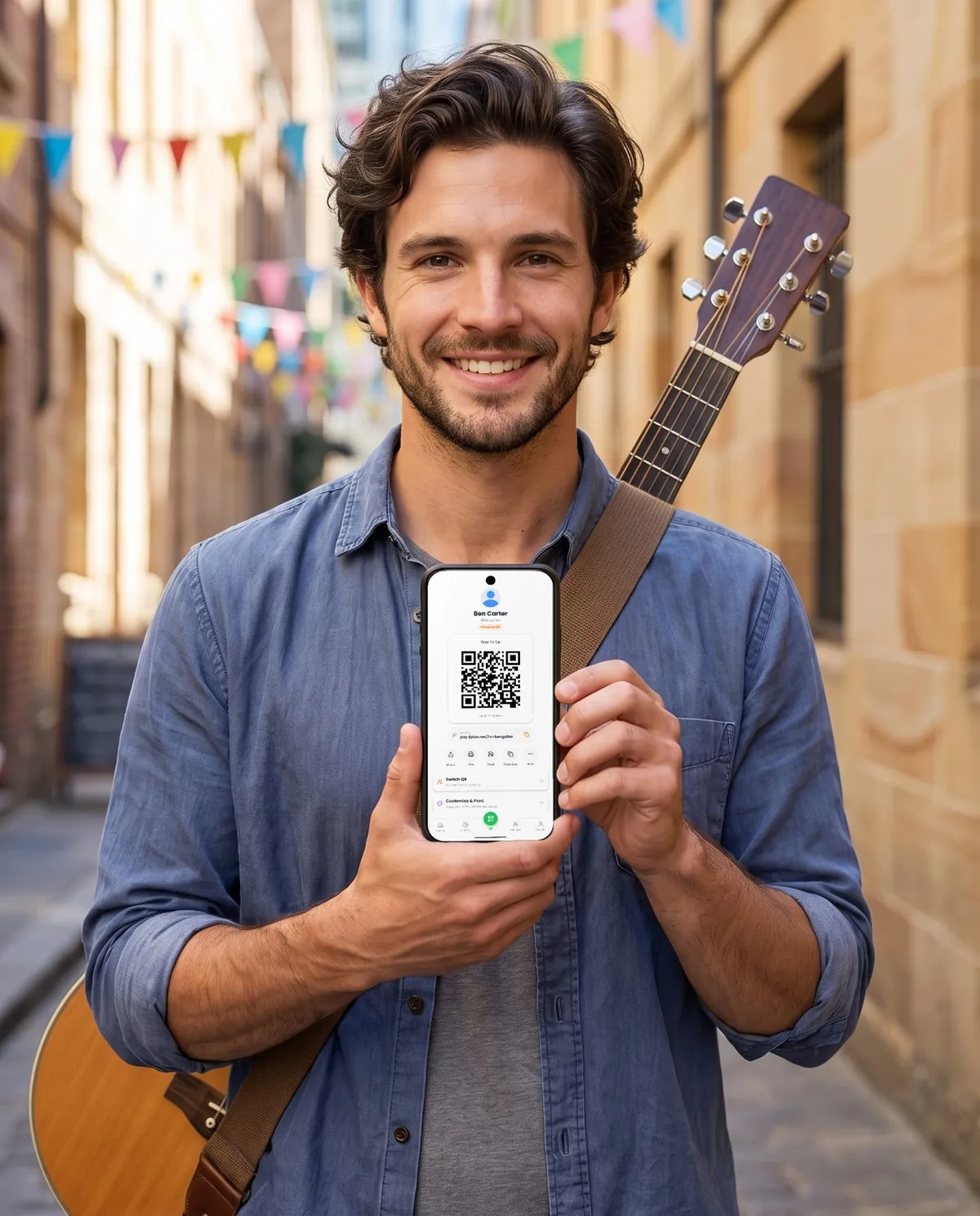
Fewer people carry cash than they used to, so a QR code sign helps. With TipIns, listeners scan your code and tip by card, Apple Pay or Google Pay, and visitors can pay with a card from another country. Our digital tip jar guide explains the setup.
World busking map: Permit rules for 131 cities on one map.
Common questions
Is busking legal in the United States?
Yes, street performance is generally treated as protected expression. Cities can still set content-neutral rules on time, place and manner, such as noise limits, permits in certain zones and keeping sidewalks clear.
Do you need a permit to busk in the US?
It depends on the city. Boston, Austin and Portland need none on the street, Chicago requires a licence, and New York only needs a permit if you use an amplifier.
Can a city ban amplifiers for buskers?
Cities can regulate volume, and the Supreme Court upheld New York's sound amplification guidelines in Ward v. Rock Against Racism (1989). Many cities limit or ban amplification in specific areas.
Can police make me stop busking in the US?
Police can enforce local noise, obstruction and permit rules, and Chicago's rules let them pause a performance if a crowd blocks the sidewalk. Stay calm, move if asked and keep any permit with you.
Do I need a permit to busk in the New York subway?
No. Anyone can perform in subway stations if they follow MTA rules, including no amplification on platforms. Music Under New York is an optional audition programme with scheduled spots.

 App Store
 Google Play