
Short answer: Amplifier rules are stricter than general busking rules. Some cities ban amps outright, some need an extra sound permit, and many allow small battery-powered amps within a volume limit, often written as decibels at a set distance or as how far away you can be heard. Check the city's own rules before you plug in.
The three kinds of amplifier rule
Most cities fall into one of three groups:
- Banned. No amplification at all, sometimes city wide and sometimes only in certain streets, malls or stations. Amsterdam and the Toronto city permit work this way.
- Extra permit. You can use an amp, but only with a second permit on top of (or instead of) a busking permit. New York City and Dublin are examples.
- Allowed with limits. Amps are fine within a volume limit, a battery-only rule or set hours, as in Melbourne and Liverpool.
Being allowed to busk does not mean you are allowed to amplify. Read both sets of rules.
How volume limits are written
Cities describe loudness in two ways. Some give a decibel figure measured at a set distance, such as 72 dB at 3 metres in Melbourne or 85 dBA at 25 feet in Las Vegas. Others use an audibility test: your sound should not be heard beyond a certain distance, such as 50 m in Sydney and Adelaide or 100 feet in Portland. A few simply ask you to stay at or just above normal street noise, as in Bath and Bristol.
A free sound meter app on your phone gives you a rough idea, but it is not a calibrated meter. The simplest check is to walk the stated distance away while a friend plays, and turn down if you can still clearly hear the music.
Battery power only
Where amps are allowed, many cities require them to be battery powered, and almost none let you plug into buildings or street power. Rules in the data include:
- Melbourne, Hobart, Byron Bay and Singapore: amplification must be battery powered.
- Calgary: only small, portable, battery-powered amps, and none in parks.
- Vancouver: battery amps only for instruments that need them to be heard, and no voice amplification.
- Liverpool: a small battery amp at ground level; petrol or diesel generators are banned.
- Santa Monica: no generators or plugging into buildings, and speakers on the ground no more than three feet high.
- Helsinki: no amplification using an external power source. Winnipeg: you may not plug into public or private power.
Australia and New Zealand
| City | Amplifier rule |
|---|---|
| Sydney | Sound should not be audible 50 m from your pitch; louder acts may need assessment. |
| Melbourne | Battery only. 72 dB at 3 m (79 dB in Bourke Street Mall). Amps 8am to 10pm Sunday to Thursday, to 11pm Friday and Saturday. No amps outside Flinders Street or Southern Cross stations. |
| Brisbane | No amplifiers, PA systems, speakers, keyboards, electric guitars or turntables in the malls. |
| Perth | Amps allowed everywhere except Hay Street Mall. |
| Adelaide | Amplified sound must not be heard beyond 50 m. In Rundle Mall, amps only in James Place. |
| Hobart | Battery only, and only at Franklin Square, Railway Roundabout, University Rose Gardens, Legacy Park and Morrison Street (Morrison Street 5pm to 8pm, Monday to Saturday). |
| Auckland | Amplified sound 7am to 9pm, 50 m from other sound acts, no louder than background noise at 30 m. |
| Wellington | Loud acts using amps are reviewed before a licence is issued. |
| Byron Bay | Battery only, 8am to 10:30pm. |
| Darwin | Amps only in Raintree Park, with notice the day before. |
| Fremantle | Not encouraged; only as set out in the guidelines, and officers can order the volume down. |
| Geelong | Amplified music generally not permitted. |
| Launceston | No amplification or electrically amplified instruments. |
| Dunedin | No amps at the Octagon busking spots. |
| Queenstown | Not confirmed in the current bylaw; an earlier version banned amplified sound. |
| Tauranga | No set limit; keep noise reasonable. |
United States and Canada
| City | Amplifier rule |
|---|---|
| New York City | Any amplified sound in public needs an NYPD sound device permit. Subway: no amps on platforms, 85 dBA at five feet. |
| Santa Monica | 75 dBA at 25 feet on weekday daytimes, 85 dBA evenings and weekends. Speakers on the ground, no generators. |
| San Francisco | Fisherman's Wharf spots have set levels from 73 dB to 89 dB. No amps in BART stations. |
| Seattle | No amplification at Pike Place Market; amps in city parks need a park use permit. |
| Chicago | No louder than normal conversation heard from 100 feet. |
| Boston | 70 decibels at any time, 50 decibels from 11pm to 7am. |
| Austin | Acoustic only without a permit; 85 decibel cap; not audible to homes or businesses after 10:30pm. |
| Portland | Amps allowed, but sound must not be plainly audible 100 feet away. |
| Las Vegas | 85 dBA at 25 feet, or 107 dBA at one foot. |
| Denver | Allowed with the permit; confirm the decibel cap when you apply. |
| New Orleans | Heavily restricted, especially in the French Quarter and around Frenchmen Street. |
| Savannah | Amplified sound not permitted. |
| Madison | Downtown amps need a permit, in approved spaces and time slots. |
| Burlington (Church Street) | No amplified sound. |
| Boulder (Pearl Street) | No amplified sound on Pearl Street Mall. |
| San Diego | Must not be too loud; no figure found, and Gaslamp police are reported strict. |
| Toronto | No amplified sound under the city permit. |
| Vancouver | No voice amps; battery amps only where needed; under 70 dB, aimed at an audience within 10 m. |
| Montreal | Not audible beyond 25 m; no amplified percussion or brass; some Rue Saint-Paul Est spots ban amps. |
| Calgary | No amps in parks; elsewhere small battery amps only. On CTrain platforms riders must hear announcements. |
| Ottawa | No amplified sound from 11pm to 7am; ByWard Market zones may restrict amps. |
| Victoria | No amps, except juried performers at pilot sites such as Ship Point. |
| Quebec City | Only the instruments or systems allowed at your assigned site. |
UK and Ireland
| City | Amplifier rule |
|---|---|
| London | Each borough differs. In Camden, using an amp means you need a licence. Two Leicester Square pitches are suspended after a noise abatement order. |
| Edinburgh | Audible to passers-by without disturbing homes and businesses; the council is reviewing amplification in the Old Town, Waverley Bridge and Portobello. |
| Glasgow | No amps or loudspeakers from 9pm to 8am; not audible beyond 30 m. |
| Manchester | The code of conduct says not to use amplification. |
| Liverpool | Small battery amp at ground level; no generators; no amplified brass or woodwind. Lord Street is noise sensitive. |
| Birmingham | A PSPO to August 2028 bans amps and instruments on New Street and nearby streets. |
| Bath | No louder than ambient street noise. |
| Dublin | Separate amplification permit. 80 dB near the performer, 75 dB in Temple Bar; no amps around Temple Bar Square. |
| Cork | Separate amplification permit; 75 dB near the performer. |
| Cambridge | Not plainly audible beyond about 30 m; turn down if asked. |
| Bristol | Just above street noise, without drowning out other buskers. |
| Brighton | The council advises avoiding amps and drums. |
| York and Canterbury | No amplified performance from 9pm to 8am. |
| Newcastle upon Tyne | Amplified acts need authorisation from NE1. |
| Aberdeen | Not plainly audible beyond 50 m. |
| Galway | Average 80 dB or less measured from across the street, lower on quiet streets. |
Europe and the rest of the world
| City | Amplifier rule |
|---|---|
| Amsterdam | No amplifiers or drums. |
| Berlin | Amps on public streets need a special use permit; Friedrichshain-Kreuzberg says there is currently no legal basis to approve them. |
| Barcelona | Any amp needs a municipal seal showing it meets the volume limits. |
| Munich and Hamburg | No amplifiers or recorded playback. |
| Frankfurt | No amps, speakers or megaphones; under 60 dB(A). |
| Prague, Naples, Nice and Sofia | Amplification banned (in Naples, small speakers too). |
| Madrid | Banned in sensitive central zones; noise limits elsewhere. |
| Florence | Some pitches are reserved for musicians without amps. |
| Copenhagen | Only if needed, at 60 dB, with no microphone for singers. |
| Malmo | Amps and loudspeakers need a police permit. |
| Oslo | Speakers fall under the advance notice rule; quiet hours 23:00 to 06:00. |
| Singapore | Battery only, within each location's decibel limit. |
| Seoul (Han River) | Up to 2 speakers or amps; 65 dB by day, 60 dB in the evening. |
| Taipei | MRT stations such as Xinbeitou allow no amps or electronic instruments. |
| Tokyo | Loud performance not allowed under the Heaven Artist scheme. |
| Hong Kong | Noise that annoys others is an offence under the Noise Control Ordinance. |
| Tel Aviv | Generally not allowed without an approved request. |
| Cape Town | Keep volume reasonable under the noise nuisance by-law. |
Rules change, so check the city's official page before you play. The busking map links to sources for about 150 cities.
Setting up an amp so it stays within the rules
- Put it low and close. An amp on the ground, angled towards the people in front of you, fills your pitch without carrying down the street.
- Turn down vocals first. A loud voice carries further than most instruments, and several cities restrict voice amplification.
- Check from a distance. Walk the limit distance away during your first song and adjust.
- Go quieter near homes, cafes and evening hours. Complaints are the usual reason buskers get moved on.
- Never leave backing tracks running while you take a break.
Taking tips when you are amplified
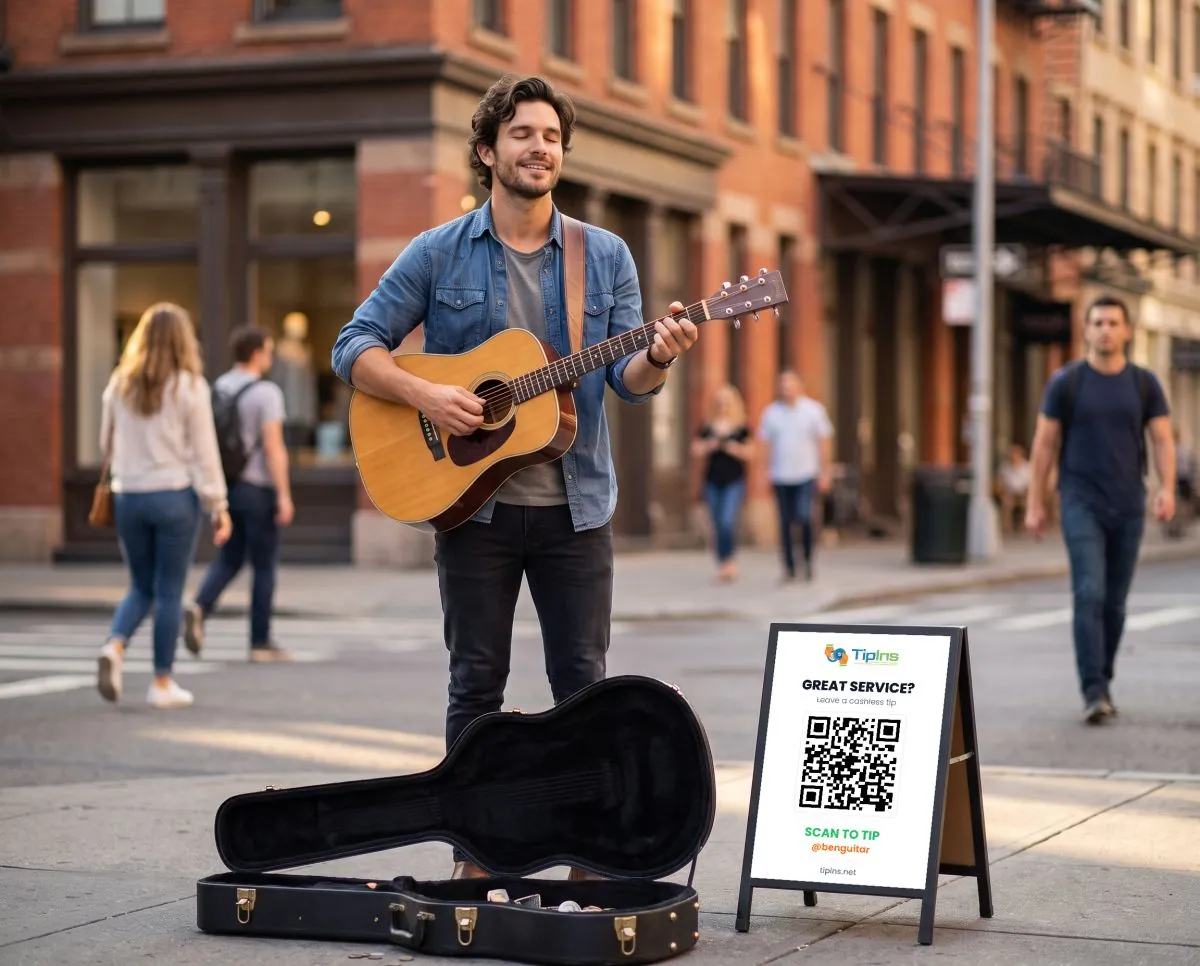
A louder act often draws a crowd that stands further back. A QR code sign that people can read from a few metres away lets them tip by card or phone without walking up to your case. TipIns codes open a payment page in the phone's browser, so listeners need no app. Make your own sign with the tip sign generator.
World busking map: Permit rules for 131 cities on one map.
Common questions
Do I need a permit to busk with an amp?
In many cities, yes. New York City needs an NYPD sound device permit for any amplified sound, and Dublin and Cork issue a separate amplification permit. Other cities ban amps entirely or allow them within limits.
How loud can a busker be?
Limits vary. Examples include 72 dB at 3 metres in Melbourne, 70 decibels in Boston and 85 dBA at 25 feet in Las Vegas. Other cities use distance rules, such as not being heard beyond 50 metres.
Can I plug my amp into a shop or street power?
Almost never. Cities such as Melbourne, Hobart, Calgary and Liverpool require battery power, and Santa Monica and Winnipeg specifically ban plugging into buildings or public power.
Why do so many cities ban amplifiers?
Amplified sound carries much further than an acoustic act and is a common cause of noise complaints from homes and businesses. Birmingham now bans amps on several core streets under a PSPO, and Edinburgh is reviewing amplification at its complaint hotspots.
Can I use a backing track while busking?
Often only where amplification is allowed, since you need a speaker to play it. Montreal limits backing tracks to 25 metres of audibility, and Munich and Hamburg do not allow recorded playback.

 App Store
 Google Play