
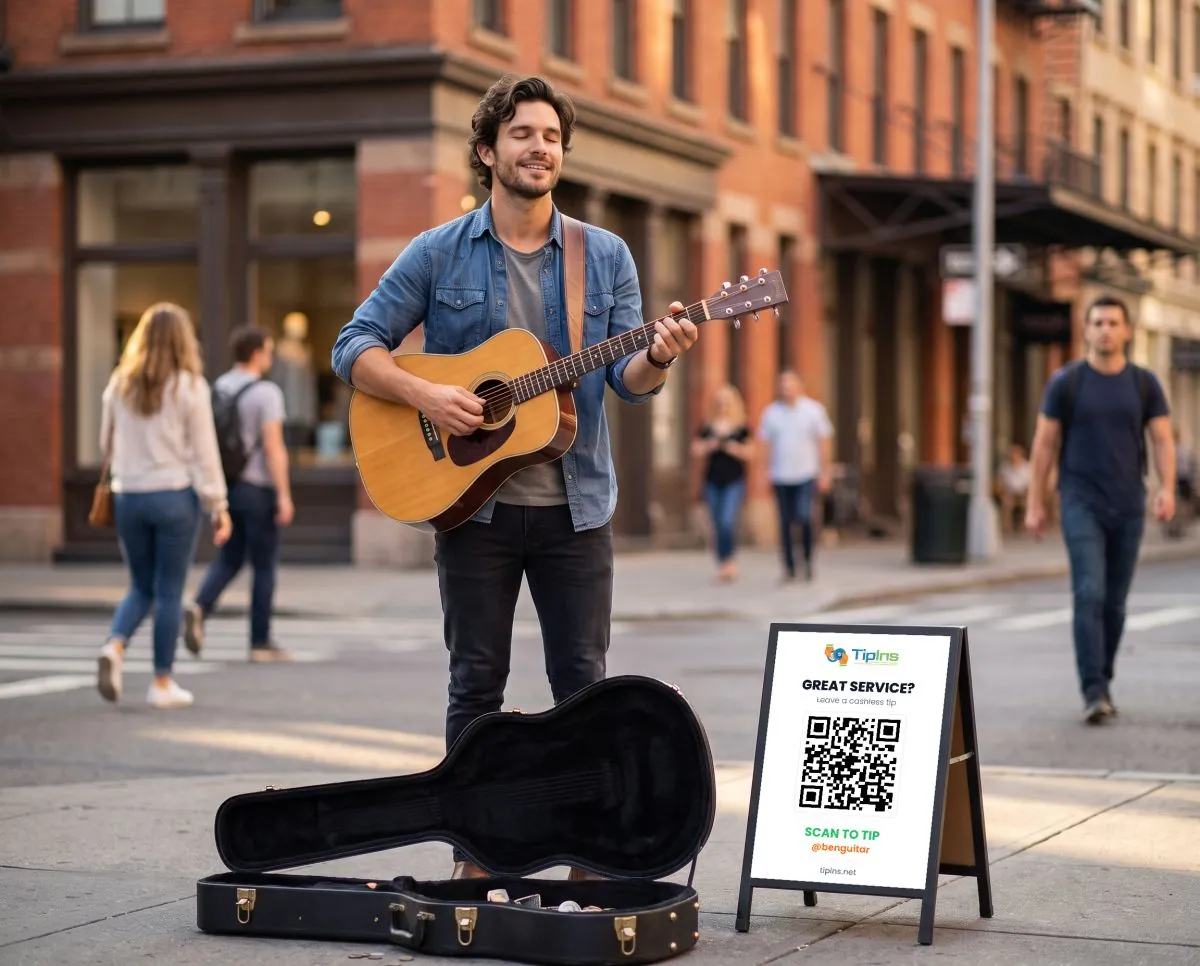
Short answer: It depends on the city, and sometimes on the exact street. Some cities need no permit if you follow a code of conduct, some need a permit everywhere the council manages, and many only ask for one in certain zones or if you use an amplifier. Transit stations and private land almost always have their own separate rules.
Busking rules are local
There is no single national busking permit in the US, the UK, Canada or Australia. The rules are set locally: a city council, a borough, a transit agency or a private landowner decides who can perform on its ground. That is why a musician can play freely in one city and need an audition in the next.
Almost every city's rules fall into one of three kinds:
- No permit needed, as long as you follow a code of conduct on volume, time and spacing.
- Permit required everywhere the council manages.
- It depends on where you stand or what you bring: a permit only for certain streets, for amplifiers or for larger acts.
The world busking map shows which kind applies in about 150 cities, so it is a quick first check before you travel.
Cities where no permit is needed
In these cities you can turn up and play, but there is still a code you are expected to follow, and police or council officers can ask you to move or turn down.
- Edinburgh: no licence. Council guidance says busk between 9am and 9pm, move at least 50 metres after an hour and keep 50 metres from other buskers.
- Glasgow, Liverpool and Bath: no licence, with a voluntary code or guide agreed with the council.
- Manchester: no licence, but the council's code says not to use amplification, drums or trumpets.
- Boston: the city neither requires nor issues street performer permits. Sound must stay under 70 decibels.
- Austin: no permit on the street, but acoustic only.
- Portland: no permit. The enforceable rule is the noise code; the time and spacing rules are community guidelines.
Cambridge, Bristol and Cape Town also run on guidelines rather than permits. In Scotland, police can still order a busker to stop under section 54 of the Civic Government (Scotland) Act 1982, so "no permit" never means "no rules".
Cities where you need a permit everywhere
Here the council expects every busker on its land to hold a permit. Costs range from free to a modest annual fee.
| City | Cost | Worth knowing |
|---|---|---|
| Sydney | A$15 for 3 months or A$52 for a year | Lodge in person with photo ID; online applications are not processed |
| Melbourne | A$42.30 for 12 months (general area) | Apply online with a video link of your act |
| Perth | Free | Send a video filmed in the last six months instead of auditioning |
| Auckland | Free | Carry the licence and photo ID while performing |
| Chicago | $100 for two years | Applicants must be 18 or over |
| Toronto | CA$55.91 a year | No amplified sound under the city permit |
| Dublin | €30 a year, or €10 for a 2-week visitor permit | An amplifier needs a second permit |
Adelaide, Hobart, Wellington, Calgary and Cork also fall in this group, as do smaller cities such as Darwin and Byron Bay.
Cities where it depends on the spot or the setup
This is the most common pattern, and the one that catches people out. Two kinds of trigger come up again and again.
A permit only in certain zones
- Santa Monica: a permit is needed on the Third Street Promenade, the Pier and the Transit Mall area, except before noon on non-holiday weekdays.
- Brisbane: a licence, won by audition, is required in the city malls.
- Seattle: no general city permit was found, but Pike Place Market has its own busker permit.
- Denver: a free permit from the Downtown Denver Partnership is needed on 16th Street.
- Vancouver: most sidewalks need a permit, but a list of named spots, such as the Vancouver Art Gallery sidewalks, needs none.
A permit only for amplifiers or bigger acts
- New York City: acoustic sidewalk playing generally needs no permit, but any amplifier needs an NYPD sound device permit.
- Camden in London: a licence is only needed for amplifiers, drums, most wind instruments, dangerous props, groups of three or more, or playing outside 10am to 9pm.
- Berlin (Friedrichshain-Kreuzberg): unamplified playing Monday to Saturday from 6am to 10pm needs no permit, while amplifier equipment on the street needs a special use permit.
Places a city permit does not cover
Even with a valid city permit, some ground belongs to someone else.
- Train and subway stations. Sydney and Melbourne permits do not cover train stations, the Chicago licence does not cover CTA or Metra, and Toronto's subway uses its own audition-based scheme. New York is unusual: anyone may perform in subway stations if they follow the MTA rules, with no amplification on platforms.
- Private or separately managed land. The Covent Garden Market Building runs its own auditions, Liverpool ONE needs permission from its management, and Federation Square in Melbourne is not covered by the council permit. In Sydney, Circular Quay, The Rocks, Darling Harbour and Barangaroo are managed by Placemaking NSW.
- Parks. New York and Austin both treat city parks separately from sidewalks.
Extra permission you may need even in a free city
- Selling CDs or merch. Glasgow requires a street trader's licence, Bath requires street trading consent, and Melbourne charges an extra A$112 to sell CDs, DVDs or artworks.
- Collecting for charity. Birmingham and Liverpool both require a separate permit or licence for charity collections.
- Collecting money at all. In the City of London (the Square Mile), street performers may not collect money.
- Dangerous acts. Auckland asks for a Special Street Performance Licence for fire, weapons or heights, and Perth does not accept fire or knife acts as busking.
- Age. Many cities ask for parental consent for under-16s or under-18s, and Birmingham does not allow children of compulsory school age to busk.
How to check the rules before you play
- Look up the city on the busking map or its city page here to see which of the three kinds applies.
- Open the council's own busking page and read the current conditions. Rules change: Toronto banned busking around Sankofa Square in April 2026, and Cork introduced permits in May 2024.
- Work out who manages your exact pitch: council street, transit agency, park or private estate.
- Check the add-ons: amplifier, selling, group size and age.
- Carry your permit and photo ID if you have one, and be ready to move politely if asked.
Once you are set up legally
With the paperwork sorted, the next question is how people pay you. Many people have no coins on them, so a QR code sign lets them tip by card, Apple Pay or Google Pay without downloading anything. TipIns is free for performers and the listener covers the fees by default. Where a code asks you not to actively ask for money, as in Manchester and Bath, keep the sign low-key beside your case. See how a digital tip jar works.
World busking map: Permit rules for 131 cities on one map.
Common questions
Is busking legal without a permit?
In many cities, yes. Edinburgh, Boston, Austin and Portland need no busking permit, although you must still follow local noise and conduct rules. Other cities, such as Sydney, Chicago and Dublin, require one.
What happens if you busk without a permit where one is needed?
Usually you are asked to stop or move on first, but fines are possible. In Cork, for example, a breach can bring a €75 fixed payment notice, or a fine of up to €1,500 on conviction.
Do I need a permit to busk with an amplifier?
Often, even where acoustic busking is free. New York needs an NYPD sound device permit for any amplifier, Dublin has a separate amplification permit, and Toronto's city permit does not allow amplified sound at all.
Do I need a permit to busk in the subway?
Transit systems set their own rules. Anyone can perform in New York subway stations under MTA rules, Boston's MBTA asks for a $25 permit, and Toronto's TTC only allows musicians who passed its audition.
Does a busking permit from one city work in another?
No. Permits are issued by each council or land manager, and even neighbouring London boroughs have different rules. A City of Sydney permit does not even cover Circular Quay or Darling Harbour.

 App Store
 Google Play