
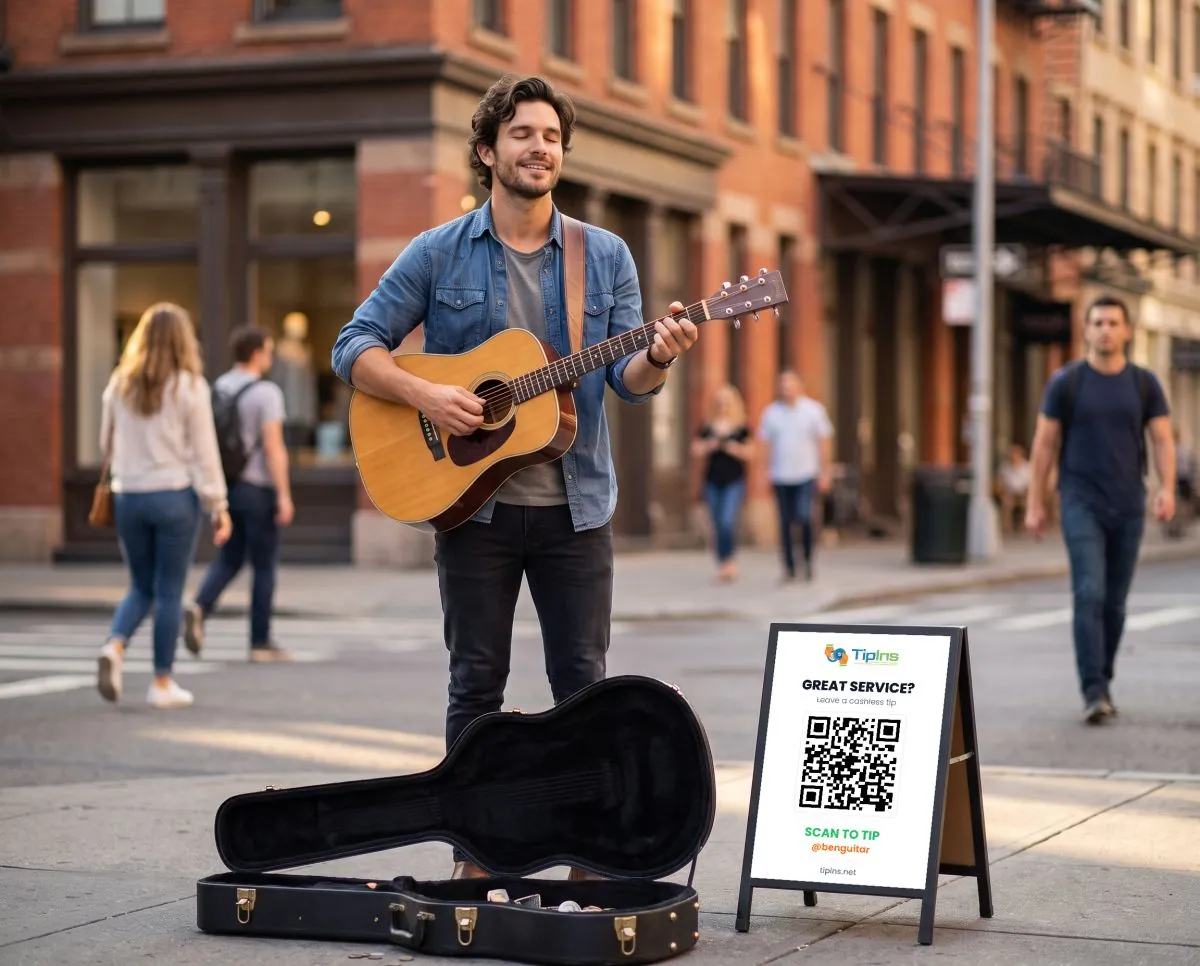
Short answer: The best busking instruments carry well outdoors without an amp, are light enough to carry between pitches and are allowed under local rules. Acoustic guitar with voice, violin, accordion, ukulele and saxophone are common choices. Drums, brass and amplified instruments draw attention but are restricted or banned in many cities.
What makes an instrument good for busking
- It carries without an amp. Many cities ban or limit amplification, so an instrument that projects on its own gives you the most places to play.
- It is portable. Time limits per spot mean moving several times a day.
- It sounds complete on its own. Passers-by hear a few seconds. A melody or a voice with chords makes sense instantly.
- It is allowed. Several cities single out drums, brass and electronic instruments.
- It is visual. People notice an unusual instrument or one that is fun to watch.
Common busking instruments compared
| Instrument | Carries outdoors | Portability | Rules to watch |
|---|---|---|---|
| Acoustic guitar and voice | Moderate; needs a wall behind you | Good | Few, unless amplified |
| Violin or fiddle | Good; cuts through street noise | Very good | Few |
| Accordion | Good | Heavy but self-contained | Few |
| Ukulele | Low on its own | Very good | Few |
| Saxophone and brass | Very loud | Good | Banned or licensed in some cities |
| Drums and percussion | Very loud | Varies | Often restricted |
| Keyboard or electric guitar | Needs an amp | Moderate | Needs amp rules to allow it |
| Harp, cello, double bass | Moderate | Difficult | Few, but space limits may apply |
| Bagpipes | Very loud | Good | Excluded in some German cities |
Acoustic guitar and voice
The classic busking setup. Familiar songs are recognisable within a few bars, and you can sing along with the crowd. The downside is that an acoustic guitar is fairly quiet outdoors, so pitch choice matters: a wall or shop front behind you helps a lot. Many guitarists add a small battery amp where it is allowed, which our amplifier rules guide covers city by city.
Violin, accordion and other melody instruments
A violin projects well, is easy to carry and works for classical, folk, pop and film music. Accordions are loud enough for squares and markets and need no power. Flutes and clarinets carry less but suit quieter streets. Melody instruments tend to work well in places where amps are banned, such as Amsterdam or under the Toronto city permit.
Brass, drums and loud instruments
Loud instruments stop people in their tracks, but they are the most restricted. Examples from our data:
- Manchester's code says not to use drums, trumpets or other loud instruments.
- In Camden, drums and wind instruments (flutes and recorders excepted) need a licence.
- Amsterdam does not allow drums or other percussion.
- Liverpool asks drummers to use brushes and damping, not sticks, and not to amplify brass or woodwind.
- Montreal does not allow amplified percussion or brass.
- Birmingham bans all instruments on New Street and nearby streets until August 2028.
- Munich does not approve brass, saxophone, drums, bagpipes or electronic instruments, and Hamburg excludes similar loud instruments.
If you play something loud, choose wider spaces away from homes, keep sets shorter and check the busking map for each city.
Keyboards and electric instruments
A keyboard or electric guitar needs an amp, which limits where you can play. Brisbane does not allow keyboards or electric guitars in the malls, and cities such as Calgary and Melbourne require battery power. If you go electric, choose gear that runs all day on batteries and sounds good at low volume.
What earns the most
There is no instrument that guarantees tips. What earns is the combination of how well you play, how recognisable your music is, where and when you play, and how easy you make it to tip. Some patterns hold up, though:
- Instruments people rarely see on the street, such as a harp or a hang drum, draw curiosity.
- A strong voice with familiar songs gets people singing along and staying.
- Acts people can watch, such as loop pedals or fast fiddle playing, hold attention longer.
Whatever you play, give people a way to tip without coins. A QR code sign lets listeners tip by card, Apple Pay or Google Pay from their phone. If you play in a duo or band, TipIns Groups can split every tip between members automatically.
World busking map: Permit rules for 131 cities on one map.
Common questions
What is the easiest instrument to busk with?
An acoustic guitar or ukulele with voice is the simplest: light, familiar to audiences and allowed almost everywhere when played without an amp.
What instrument makes the most money busking?
No instrument guarantees more tips. Playing quality, song choice, pitch, timing and how easy it is to tip matter more than the instrument itself.
Can I busk with drums?
In some places. Amsterdam does not allow drums, Manchester's code advises against them, Camden needs a licence and Liverpool asks for brushes and damping. Check the city's rules first.
Is a violin good for busking?
Yes. It projects well outdoors, is easy to carry, needs no power and suits many styles, which makes it useful in cities that ban amps.
Do I need an amp to busk with a guitar?
No. Many guitarists play acoustically with a wall behind them. An amp helps in noisy spots but is banned or limited in many cities.

 App Store
 Google Play