
Short answer: Most UK cities need no busking licence, but expect you to follow a council code on volume, time and spacing. London is decided borough by borough, with licences in Westminster and for louder acts in Camden, and the Tube needs a TfL licence won by audition. In Ireland, Dublin and Cork both require a street performance permit.
How busking is regulated in the UK
There is no national busking licence in the UK. Each council decides, and most have chosen a voluntary code of conduct rather than a licence. A few, such as Westminster, license buskers in their busiest areas. Councils also have wider powers they can use against persistent problems, including Public Spaces Protection Orders (PSPOs) and Community Protection Notices.
The world busking map marks each UK and Irish city by permit status, and the city pages below have the full detail.
Cities with no licence, just a code
| City | Main points of the code |
|---|---|
| Edinburgh | 9am to 9pm; move at least 50 metres after an hour; 50 metres from other buskers |
| Glasgow | Not audible beyond 30 metres; no amplifier between 9pm and 8am; two hours per spot |
| Manchester | 90 minutes per spot, not back within 24 hours; the code says no amplification, drums or trumpets |
| Liverpool | 50 metres between performers; small battery amps at ground level allowed; circle shows only in three places |
| Bath | 10:00 to 20:00; about an hour per pitch; follow the Abbey's traffic-light noticeboards |
Cambridge, Oxford, Bristol, Brighton, York, Leeds, Cardiff, Newcastle and Canterbury also need no licence and use codes or guidelines. Details differ: Newcastle's code says perform only from 9am to 6pm, and amplified acts there need authorisation from NE1, the city centre business body. Leeds City Council's guidance also mentions a PRS licence if you perform copyright music.
London: borough by borough
In London each borough sets its own rules.
- Westminster (including Leicester Square, Trafalgar Square and Covent Garden's outdoor piazzas): you need a council licence and must use a designated pitch in the regulated areas. It costs £20 for 6 months or £10 for 1 month, the code limits busking to 10am to 9pm, and sets should last no more than 40 minutes. Applications need photo ID, a right-to-work declaration and public liability insurance of more than £2 million. Pitches are often suspended for events.
- Camden: a licence (£150 for 24 months) is only needed if you use an amplifier, drums or most wind instruments, dangerous props, perform outside 10am to 9pm or in a group of three or more.
- City of London (the Square Mile): street performers are not allowed to collect money.
- Covent Garden Market Building: a private estate with its own auditions and a list of banned instruments, including brass, drums and electric guitars.
The London Underground
Busking on the Tube is only allowed for performers licensed through TfL's audition-based scheme, playing on marked pitches. TfL said the next auditions were expected in late 2026. Playing elsewhere in a station without a licence is not allowed.
PSPOs and other powers
A Public Spaces Protection Order lets a council ban specific activities in a defined area. Birmingham is the clearest example: busking on public land needs no licence, but a PSPO running from August 2025 to August 2028 bans musical instruments and amplification on New Street, Temple Street, Cannon Street, Needless Alley and part of Waterloo Street. In Liverpool, by contrast, the city PSPO does not restrict busking as long as the guide is followed.
Other enforcement tools include:
- Community Protection Notices, which Bath says can follow persistent problems.
- Section 54 of the Civic Government (Scotland) Act 1982, under which Police Scotland can order a busker to stop. In Edinburgh, refusing can lead to a report to the Procurator Fiscal and seizure of equipment.
- Noise abatement orders. Leicester Square pitches 8 and 9 have been suspended since April 2025 after a magistrates' court order.
Selling CDs and collecting for charity
Selling is usually street trading, and needs its own permission even where busking is free. Glasgow requires a street trader's licence, Bath and York require street trading consent, Bristol requires a street trading licence (with no street trading in Broadmead), and Westminster requires a temporary street trading permission on top of the busking licence. Liverpool lets you offer CDs for a voluntary contribution with the council's A4 sign. Collecting for charity needs a street collection licence or permit in Birmingham, Liverpool and Newcastle.
Ireland: Dublin, Cork and Galway
- Dublin: every performer needs a Street Performance Permit (€30 a year, or €10 for a 2-week visitor permit), plus an amplification permit if you use an amp. Two hours per location (one hour on Grafton Street), starting and finishing on the hour, no backing tracks, 80 decibels near the performer (75 in Temple Bar), and no performing from 11pm to 9am.
- Cork: since 20 May 2024 you need a permit (€30 a year, waived for under-25s, or €10 for 3 months), and you must perform within 3 metres of one of the council's location markers. Breaches can bring a €75 fixed payment notice.
- Galway: the council page lists rules on volume, hours and spacing, such as starting no earlier than 10am and keeping 40 metres from other performers, and mentions no permit. Confirm with the council before you play.
Children and young buskers
Birmingham does not allow children of compulsory school age to busk. Liverpool's guide says under-14s may not busk and older children should be with a parent and not busk in term time. In Cork, under-16s may only perform with a legal guardian present.
Taking card tips
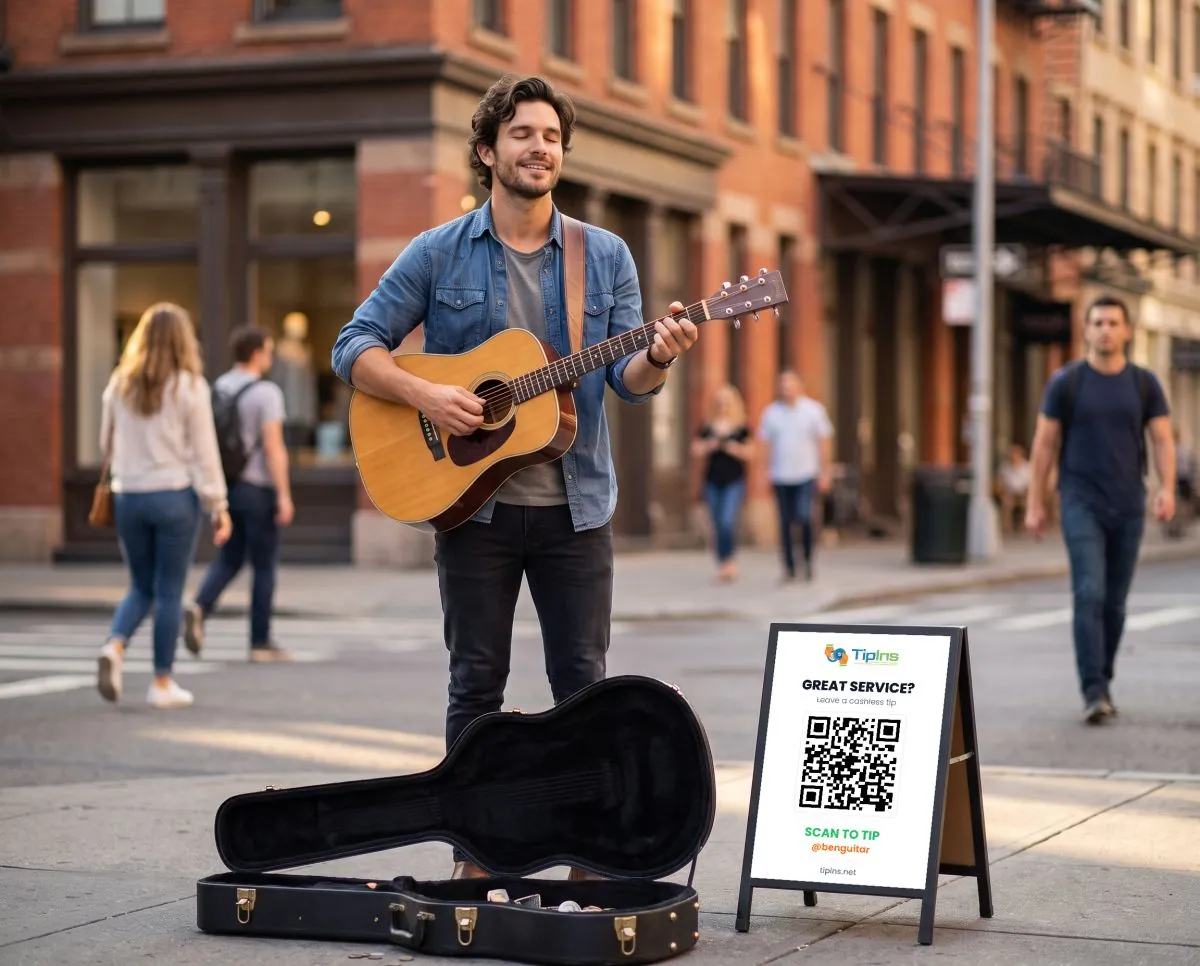
Liverpool's busking guide itself encourages card readers for donations. A QR code sign does the same job without hardware: listeners tip by card, Apple Pay or Google Pay through TipIns. Where a code says not to ask for money, as in Bath and Manchester, keep the sign by your case rather than pointing at it.
World busking map: Permit rules for 131 cities on one map.
Common questions
Do you need a licence to busk in the UK?
In most UK cities, no. Edinburgh, Glasgow, Manchester, Liverpool and Bath use voluntary codes, but parts of London, such as Westminster, require a licence and a designated pitch.
Can you busk anywhere in London?
No. Each borough has its own rules: Westminster licenses pitches, Camden licenses louder or larger acts, the City of London does not let performers collect money, and the Tube needs a TfL licence.
How do you get a busking licence for the London Underground?
You must pass one of TfL's auditions. Licensed performers then play on marked pitches. TfL said the next auditions were expected in late 2026.
Can police stop you busking in the UK?
Yes, if you cause a nuisance or break local rules. In Scotland police can order you to stop under section 54 of the Civic Government (Scotland) Act 1982, and councils can use PSPOs and Community Protection Notices.
Do you need a permit to busk in Dublin?
Yes. Every performer needs a Dublin City Council Street Performance Permit, costing €30 a year or €10 for a 2-week visitor permit, and amplifiers need an extra permit.

 App Store
 Google Play