

Short answer: To start busking, check whether your city needs a permit, prepare at least 30 to 60 minutes of material you can play without stopping, and pack light: your instrument, something to collect tips in and a clear sign. Then pick a pitch where people walk slowly or wait, play your strongest songs first and make it easy to tip by coin, note or card.
Step 1: check the rules where you want to play
Busking rules are set city by city, and sometimes street by street. Before you buy anything or learn a single extra song, find out which of three situations you are in:
- No permit needed. You can play as long as you follow a code of conduct or noise limits. Edinburgh and Manchester work this way.
- Permit required. You apply to the council or city first. In Sydney you lodge the form in person with photo ID, and in Toronto the city permit does not allow amplified sound.
- It depends where. Ordinary sidewalks may be free, while markets, malls, parks and transit stations have their own rules. New York City needs no permit for acoustic sidewalk playing but needs a sound device permit for any amplifier.
The world busking map shows the permit status for about 150 cities, and each city page links to the official source. Some permits involve an audition, such as the one in Brisbane, so leave time for that.
Step 2: prepare enough material
You do not need a huge repertoire, but you do need enough to keep going without long gaps. Aim for 30 to 60 minutes of songs or routines you can play confidently while people talk, walk past and drop coins in front of you.
Some cities write this into their rules. Dublin and Cork expect musicians to have enough repertoire for at least 30 minutes without repeating. Even where there is no rule, people who stop for a few minutes notice when you repeat the same song.
- Pick songs that sound good on their own, without a full band behind them.
- Practise standing up, outdoors if you can, because your voice and timing feel different outside.
- Have a short version of each song ready for when a crowd is drifting.
Our guide to building a busking set list goes into order and pacing.
Step 3: pack light for your first day
For a first session, less is better. You will be carrying everything, setting up in public and packing down quickly if you need to move.
- Your instrument, spare strings or reeds, and a tuner.
- An open case, hat or box for tips, placed where people can reach it.
- A sign with your name and how to tip.
- Water, a small towel and something to sit on if your act allows it.
- Your permit and ID, if your city requires them.
Leave the amplifier at home for your first go unless you know the rules allow it. Many cities limit or ban amplification, and an acoustic set is the simplest way to learn what works. The busking gear checklist covers everything you might add later.
Step 4: choose your first pitch
The best beginner pitch has steady foot traffic moving at a walking pace, somewhere for people to pause without blocking anyone, and a wall or building behind you to carry the sound. Squares, wide pedestrian streets and spots near cafes tend to work better than busy junctions where everyone is rushing.
Watch the spot for a few minutes before you set up. Check that you are not in front of a shop door, a bus stop or a crossing, and that no other busker is close by. Many cities set a minimum distance, often 50 metres. See how to choose a busking pitch for more.
Step 5: play your first set
- Set up quickly and quietly. Tune before you arrive if you can.
- Start with your strongest song. The first minute decides whether anyone slows down.
- Keep the gaps short. Long pauses between songs let people walk on.
- Look up and smile. Eye contact and a nod to people who stop makes a big difference.
- Watch the clock. Many cities limit how long you can stay in one spot, from 30 minutes in Amsterdam to two hours in Glasgow.
Expect your first session to feel awkward. Most people walk past, and that is normal. Count how many stop rather than how many ignore you.
Step 6: make it easy to tip
People tip when it is easy. Put a few coins and a note in your case before you start so it is clear what the case is for. Keep the case in front of you, not behind your feet.
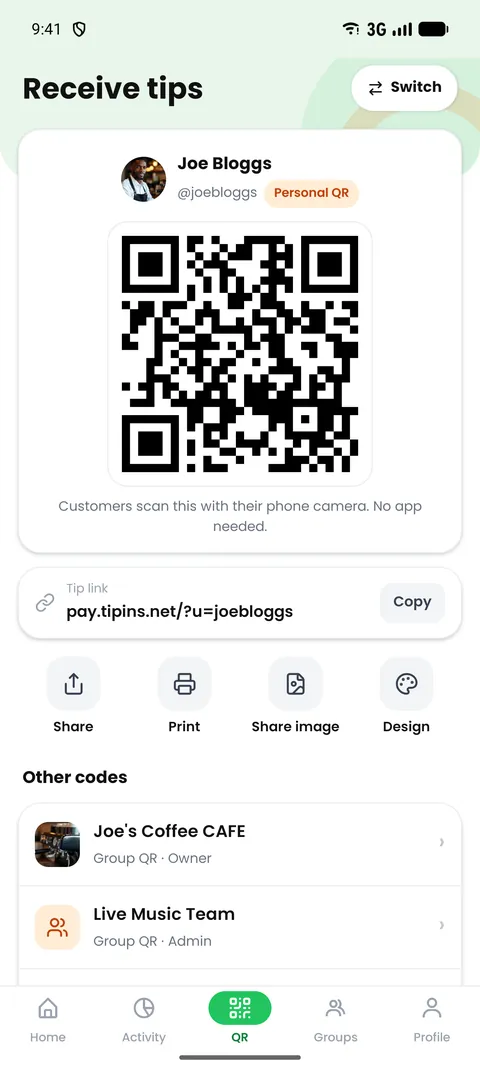
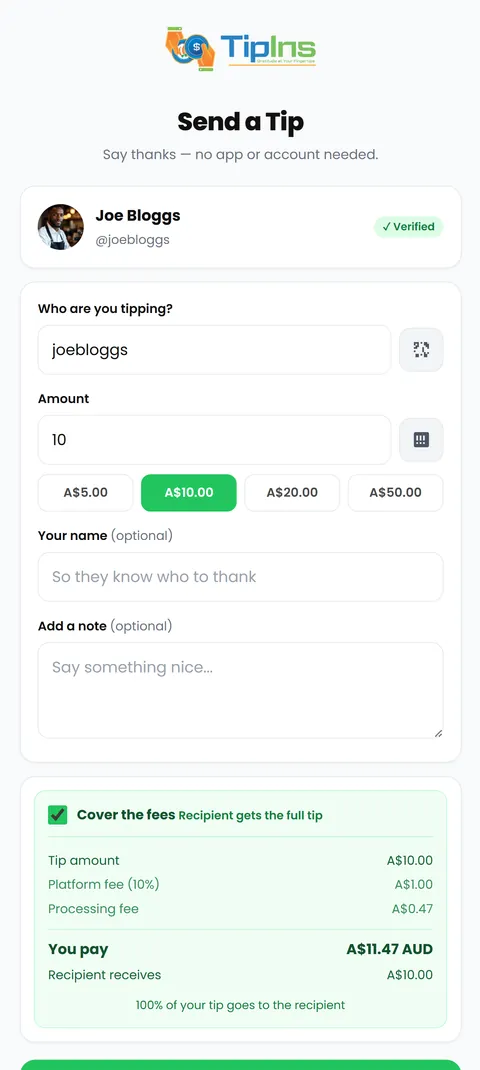
Fewer people carry cash than they used to, and many people have no coins on them when they hear something they like. A QR code on your sign lets them tip with their phone in a few seconds. With TipIns for street performers, listeners scan the code with their camera and pay by card, Apple Pay or Google Pay on a web page, with no app or account needed on their side. The app is free with no monthly fee, and by default the person tipping covers the fees, so you receive the full tip.
Step 7: learn from each session
After each session, write down a few notes: where you played, what time, how long, which songs made people stop and roughly what you took in coins and card tips. After five or six sessions you will see patterns in which pitches, days and songs work for you.
Come back to the spots that worked at the same times. Regulars are a real part of busking income, and people who heard you last week are more likely to stop again.
Money, tax and paperwork
Tips from busking are usually treated as income. The rules differ by country, so check with your tax authority, such as the IRS, HMRC, the ATO or the CRA. This is general information, not tax advice. Some councils also ask permit holders for public liability insurance, so read your permit conditions carefully.
World busking map: Permit rules for 131 cities on one map.
Common questions
Is busking legal?
In most cities busking is legal, but the rules vary. Some cities need no permit, some require one everywhere, and some only regulate certain areas like malls, markets or transit stations. Check the busking map for your city.
Do I need to be good to start busking?
You need to be comfortable playing your material without mistakes stopping you. You do not need to be a professional, but practise outdoors first, and remember that some cities, such as Brisbane, audition buskers before granting a permit.
How long should my first busking session be?
An hour is a good first session. It is long enough to see how people react and short enough to stay fresh, and many cities limit you to around an hour in one spot anyway.
What should I put in my busking case?
Put a few coins and a note in it before you start so passers-by understand it is for tips. Add a sign with your name and a QR code so people without cash can tip by phone.
Can I busk with an amplifier as a beginner?
You can where the rules allow it, but many cities ban amplifiers or need a separate permit for them. Starting acoustic is simpler. Read the amplifier rules before you bring one.

 App Store
 Google Play