
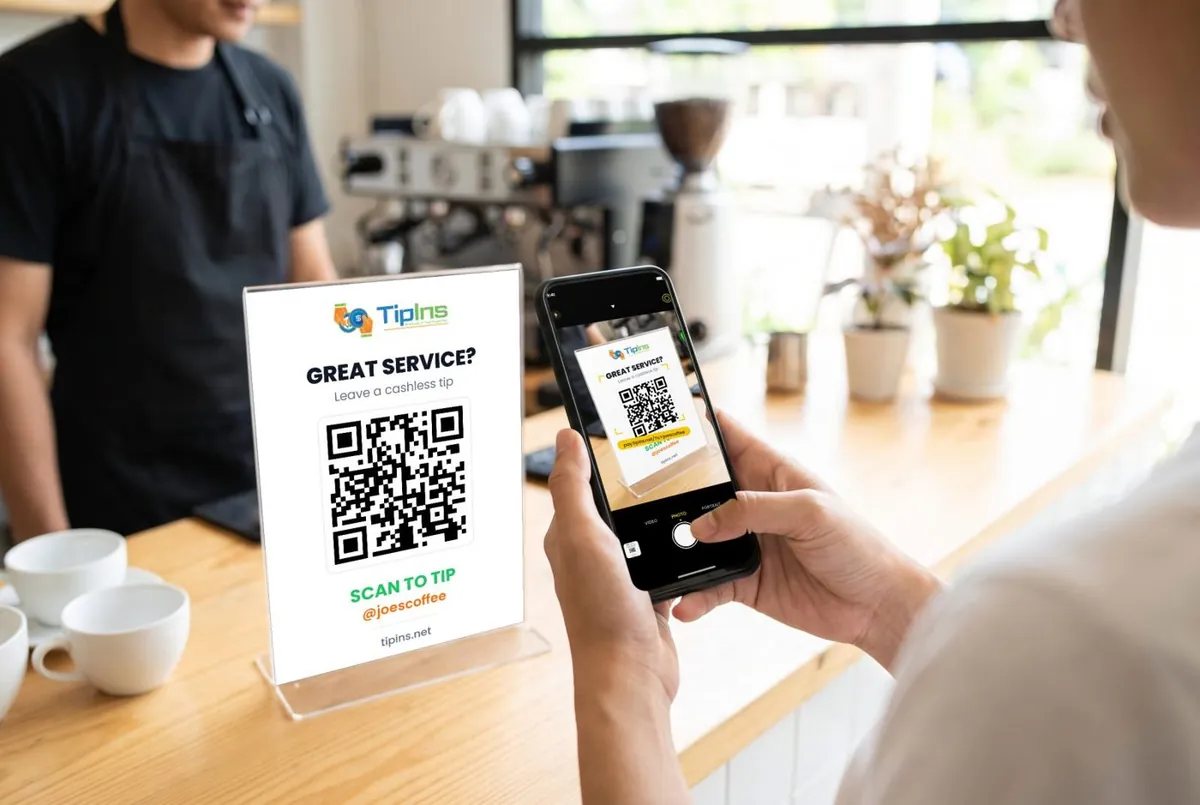
Short answer: There are three common ways to take tips without cash: a QR code that opens a tip page, a contactless card reader, and a payment-app handle on your sign. Each has trade-offs in speed, fees, gear and who can use it. Most buskers do best by offering one cashless option alongside an open case for cash.
Why cashless tips matter
Fewer people carry cash than they used to, and many have no coins on them when they pass a busker. Some would happily tip if they could. A cashless option catches those people, and tourists who have no local currency. It does not replace cash: plenty of people still prefer to drop a coin, so keep the case open.
Card tips are also a record of income, which helps at tax time. See do buskers pay tax on tips.
Option 1: a QR code tip page
You show a QR code on a sign or on your phone. The listener points their phone camera at it, a web page opens, and they tip by card, Apple Pay or Google Pay.
Good points:
- No hardware beyond a printed sign, so nothing to charge, pair or have stolen.
- Listeners can choose their own amount.
- Works while you keep playing, because you do not have to touch anything.
- One printed sign can sit at the front of every pitch.
Downsides:
- It takes longer than dropping a coin: take out a phone, open the camera, scan, pay. Some people walking past will not stop for that.
- The listener needs mobile data or Wi-Fi. In some underground stations that can be a problem.
- A small or badly lit code is hard to scan. Print it large and keep it flat.
- There are fees, and you need to check who pays them.
Option 2: a contactless card reader
A small card reader, usually paired with your phone, lets people tap a card or phone to pay. Some buskers mount one on a stand with a fixed amount set.
Good points:
- Tapping is very fast and familiar from shops.
- Works for people who do not want to use their phone camera.
- Some councils actively encourage it: the Liverpool busking guide encourages buskers to use card readers for donations.
Downsides:
- You have to buy the reader and keep it charged and connected.
- Usually a fixed amount per tap, so someone who wanted to give more often does not, and someone who wanted to give less may skip it.
- It is a valuable object sitting on the pavement, so it needs watching or securing.
- Processing fees come out of each tip, and with small tips a fixed per-transaction fee is a bigger share.
- Weather, screen glare and pairing drops can stop it working mid-session.
Option 3: a payment-app handle
Some buskers write a handle from a payment app on their sign, so people can send money from the same app.
Good points:
- Often no hardware and low or no fees for personal transfers.
- Familiar in countries where one app is widely used.
Downsides:
- The tipper needs the same app, an account and usually a linked bank or card. Tourists often do not have it.
- Typing a handle is slow and easy to get wrong, so tips can go to the wrong person.
- Your name or profile may be visible to every tipper.
- Some apps separate personal and business use in their terms, so check whether receiving regular tips is allowed on a personal account.
Side by side
| QR tip page | Card reader | Payment-app handle | |
|---|---|---|---|
| Hardware | Printed sign | Reader plus phone | Printed sign |
| Speed for tipper | Medium | Fast | Slow |
| Tipper needs | Phone with camera and data | Contactless card or phone | The same app and an account |
| Tip amount | Tipper chooses | Usually fixed | Tipper chooses |
| Works for tourists | Usually, with a card from home | Usually | Often not |
| Theft risk | Low | Higher | Low |
| Fees | Check who pays | Per transaction, paid by you | Varies by app and account type |
Making any cashless option work
- Make it visible. A large sign at knee to waist height, angled towards people walking up, works better than a code taped to the case lid.
- Say it once. A quick "you can tip by card too" between songs reminds people the option exists.
- Test it before every session. Scan your own code or tap your own card at the start.
- Keep cash welcome. An open case with a few coins in it still matters.
- Follow local collecting rules. Card tips are still donations. The City of London does not allow street performers to collect money at all, and Ottawa's ByWard Market requires donations to go into a stationary container rather than being collected by roaming. Check your city on the world busking map.
How TipIns handles it
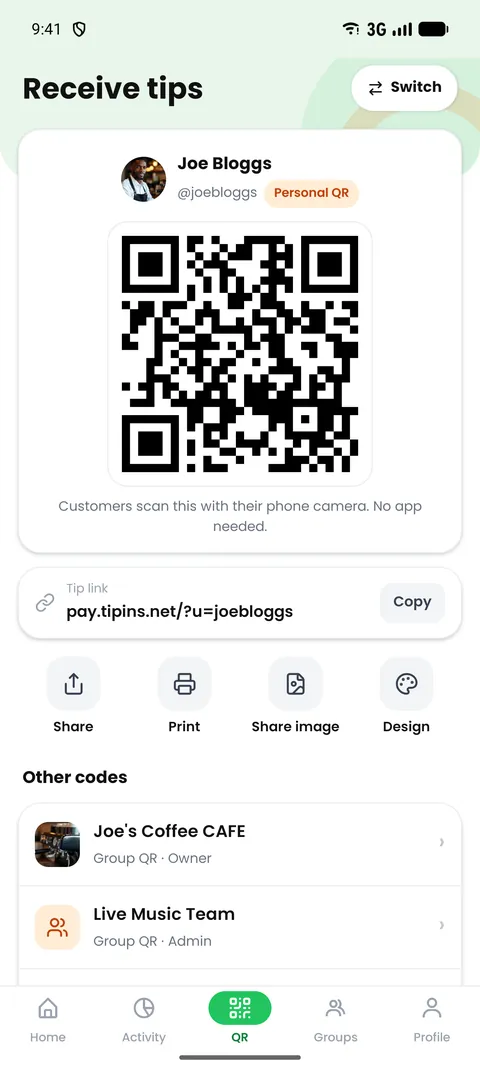
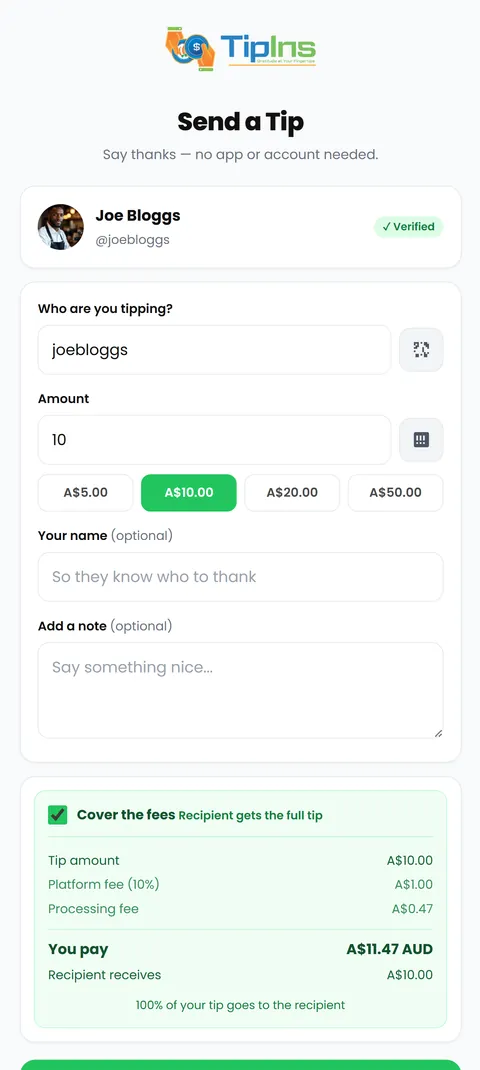
TipIns is a QR code tip page built for performers. Listeners scan with their phone camera and tip by card, Apple Pay or Google Pay on a web page, with no app or account needed on their side, and they can use a card from another country. It is free to download with no monthly fee. Each tip carries a 10% platform fee plus a small card processing fee; by default the person tipping covers both, so you receive the full tip. Weekly payout to your bank is free, and instant payout costs 2% plus a small fixed amount.
Bands can use one group QR code that splits every tip between members automatically. Print-ready sign designs export from the app in business card, A5, A4 and A3 sizes. TipIns is available in 40+ countries and the app is in 20 languages. The same downsides of any QR code apply: the tipper needs a signal, and it takes a few seconds longer than a coin.
World busking map: Permit rules for 131 cities on one map.
Common questions
Can buskers accept card payments?
Yes, in most places. Common ways are a QR code that opens a tip page, a contactless card reader or a payment-app handle. Local rules on collecting donations still apply to card tips.
Is a QR code or a card reader better for busking?
A card reader is faster for each tap but costs money, needs charging and usually takes a fixed amount. A QR code needs no hardware and lets people choose the amount, but takes a few seconds longer and needs a phone signal.
Do people actually tip buskers by card?
Some do, especially people who have no coins on them and tourists without local cash. Cashless options add to cash tips rather than replacing them, so keep your case open too.
Who pays the fees on card tips?
It depends on the service. With card readers the performer usually pays a per-transaction fee. With TipIns, by default the person tipping covers the platform and card processing fees, so the performer receives the full tip.
Can tourists tip with a foreign card?
With most card readers and QR tip pages, yes. Payment-app handles often only work for people who have that app in that country.

 App Store
 Google Play