

Short answer: there are three common methods. Split equally between everyone working, split by hours worked (tips ÷ total hours × each person's hours), or split by fixed percentages per role. Pick one, write it down, and make the numbers visible to the whole team.
Arguments about tips are rarely about the amount. They are about not knowing how the amount was worked out. A clear rule that everyone can check removes most of the friction. Here are the three methods, with the maths.
Method 1: Equal split
Everyone who worked the period gets the same share.
Example: $240 in tips, four people on. $240 ÷ 4 = $60 each.
Works well when shifts are the same length and everyone does similar work, such as a small cafe team. Falls down when one person worked three hours and another worked eight.
Method 2: Split by hours worked
The most widely used method, because it follows time on the floor.
- Add up the tips for the period.
- Add up the hours worked by everyone in the pool.
- Divide tips by hours to get a rate per hour.
- Multiply the rate by each person's hours.
Example: $220 in tips. Ana worked 8 hours, Ben 8 and Cal 6, which is 22 hours in total. $220 ÷ 22 = $10 per hour.
| Person | Hours | Share |
|---|---|---|
| Ana | 8 | $80 |
| Ben | 8 | $80 |
| Cal | 6 | $60 |
The weak point: it treats every hour as equal. Someone who worked the quiet afternoon earns the same rate as someone who worked the Friday rush, when most of the tips were actually given.
Method 3: Percentages by role
Each role, or each person, gets a fixed share. For example: servers 60%, bar 25%, kitchen 15%. Inside each role the amount is then split equally or by hours.
Works well when roles are very different and the team has agreed the weights. Falls down when the percentages were set by one person and never explained.
A fourth option: split each tip between whoever is on shift
The hours method averages a whole day. A more precise approach is to divide each tip between the people working at the moment it arrives. The Friday rush crew shares the Friday rush tips, and the person who left at three does not receive a share of a tip given at nine.
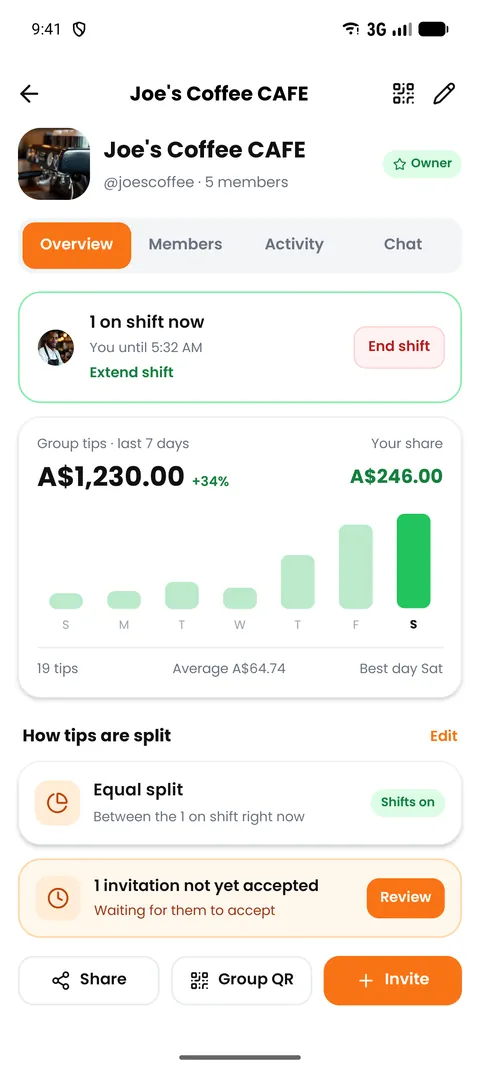
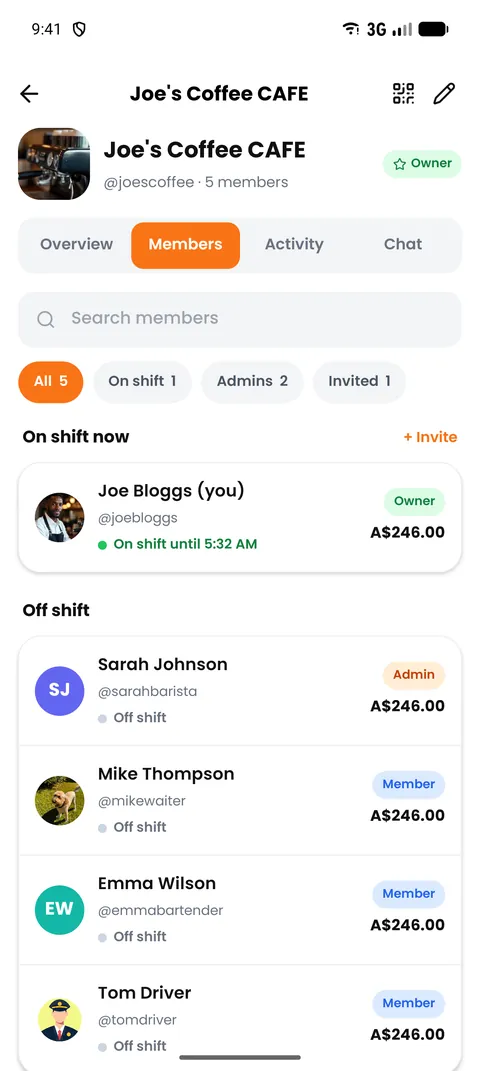
Doing that on paper is impractical. It is how TipIns groups work when active shifts are turned on: staff start a shift when they come on, and each tip is shared between the people on shift at that second. If nobody has started a shift, the tip is shared across the whole team so it is never turned away.
How to automate the split
- One person creates a group in TipIns and invites the team.
- Choose equal split or custom percentages per member.
- Optionally turn on active shifts, so only people currently working share each tip.
- Print the group's QR code and put it on the counter. See how to make a tip sign.
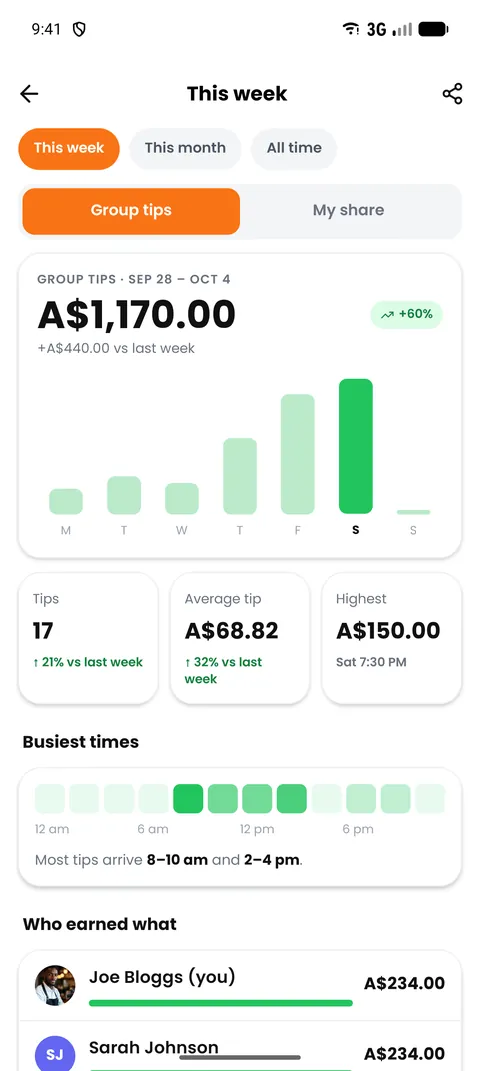
Each member's share goes to their own account and their own bank payout. Nobody holds the pot, counts a jar at close or makes transfers afterwards, and every member can see the same figures.

Rules worth checking first
- Who may be in the pool. In the United States, federal law does not allow employers, managers or supervisors to keep any part of employees' tips. Many states add their own rules.
- Tax. In most countries, including the US, UK and Australia, tips are taxable income for the person who receives them.
- Consent. Write the policy down and have the team agree to it before it starts.
This article is general information, not legal advice. Check the rules for your state or country.
Common questions
What is the fairest way to split tips?
For teams where everyone does similar work, splitting by hours worked is usually seen as fairest. Where roles differ a lot, a percentage per role agreed by the team works better. What matters most is that the rule is written down and everyone can see the numbers.
How do you split tips by hours worked?
Add up the tips and the hours worked by everyone in the pool. Divide tips by hours to get a rate per hour, then multiply that rate by each person's hours.
Can managers or owners take a share of tips?
In the United States, federal law does not allow employers, managers or supervisors to keep any part of employees' tips. Rules differ in other countries and states, so check the law where you operate.
What is the difference between tip pooling and tip sharing?
In a tip pool, all tips go into one pot and are divided by a set rule. In tip sharing, or tipping out, the people who received the tips pass a portion to supporting staff such as kitchen hands or bar backs.
Can tip splitting be automated?
Yes. With a TipIns group, customers tip one QR code and each tip is divided between members at the moment it arrives, equally or by set percentages, and paid into each person's own account.